Optimising the Accommodation Booking Journey at Amber
A series of iterative design experiments across lead collection, book forms, and US market expansion reducing agent dependency and improving booking conversion.
Amber
Amber is a global student accommodation marketplace founded in 2017, headquartered in Pune. With 1M+ beds listed across 300+ cities in 7 countries, amber serves students from over 160 countries, making it one of the largest platforms in its category. The company reached a GBV of $600M in 2022 and crossed post-tax profitability before raising $21M in its first external round, led by Gaja Capital in 2024. PR Newswire + 2
Overview
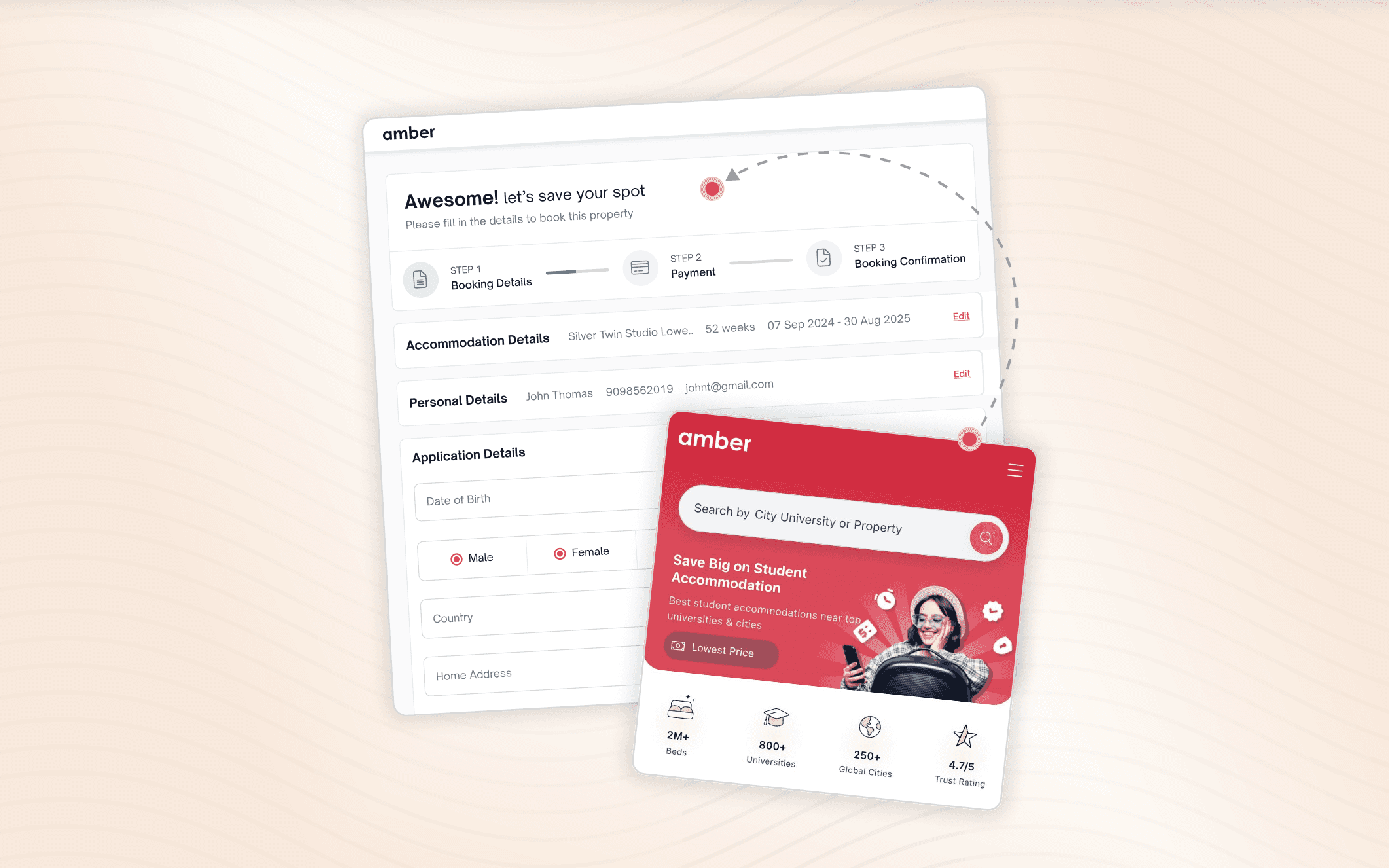
The booking journey has three stages: discover → enquire → book and pay. The book form is the highest-stakes step, where students commit financially and submit personal details for a high-ticket, low-trust decision.
This project focused on fixing a funnel that conflated enquiry intent with booking readiness, resulting in low conversion, high junk leads, and a sales team absorbing friction the product should have handled.
My Role
I owned this project end-to-end across three phases, initiated through a self-directed flow audit.
In Phase I (Apr–Jun 2024 | 3 months), I identified and framed the core problem, led stakeholder alignment, and redesigned the lead collection flow. I also established a new design–PM intake process that reduced rework across the team.
In Phase II (Jun–Aug 2024 | 3 months), I led book form optimisation, field audits with sales and supply teams, component compaction, payment clarity, and accommodation selection fixes.
In Phase III (May–Jun 2025 | 2 months), I extended the book form architecture for the US market, adding configurable PMG-level fields, document upload section and strengthened guidance nudges.
Problem
Only ~20% of leads were converting. The enquiry flow routed students directly to payment — without capturing their actual question. Sales agents were manually qualifying every lead by call, WhatsApp, and email. The book form was long, mostly incomplete on submission, and identical across markets despite significant structural differences.Three signals pointed to the same breakdown:
Behavioural
Students who clicked "Enquire" were hitting payment screens. Drop-offs spiked at the accommodation selection step, users couldn't identify their room from a text-only dropdown.
Qualitative
Sales agents reported that most students had questions about guarantors, payment types, move-in flexibility that the form never addressed. Nearly every booking required agent intervention.
Sales / Support
The US sales team flagged constant manual overrides. One global book form couldn't handle PMG-level variation in fields, fees, and documentation requirements.
Problem 1
There was no separation between enquiry and booking intent. Students with unanswered questions were routed directly into a booking commitment and payment flow, increasing confusion and creating high lead volume with low-quality intent.
Problem 2
Students lacked clarity around terms like “guarantor” and payment types, leading to drop-offs and agent dependency. The PMG-configurable booking form, built with single-market logic, was inadequate for the more complex US market requirements.
NDA
This project is under NDA. The goal was to reduce confusion and improve decision-making during booking, leading to better lead quality and higher progression. I'm happy to share the full process and outcomes in a one-on-one discussion.